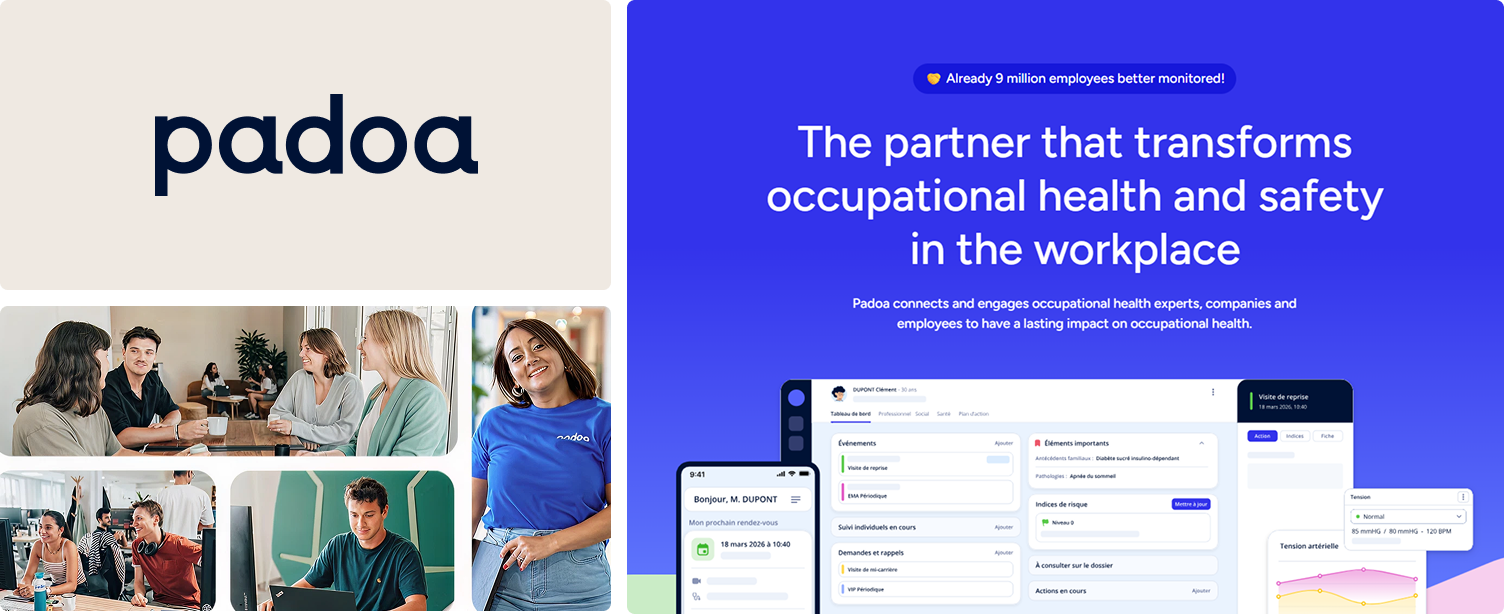
Prego was a greenfield project. Before launch, there was no transactional platform for these services. Companies looking for training, consulting, or regulatory inspections relied on manual and offline processes to find providers, compare offers, request quotes, and complete purchases.
This made the project fundamentally different from a standard eCommerce implementation. Prego does not follow a traditional add-to-cart model. Instead, it is built around a quote-based workflow, where a company submits a need, certified providers respond with tailored offers, and payment only happens once both sides agree.
The project also required a multi-store architecture, with one branded storefront per SPSTI, all managed from a single operator back office. On top of that, users needed to enter Prego seamlessly from their existing Padoa account, without logging in again, and with company information already available during the process. The system also had to connect in real time to multiple independent Padoa ERP instances to retrieve company data and route users correctly.
With a quote-based workflow, multi-store setup, SSO, and live ERP connectivity all in play, the project clearly needed a platform that could be deeply customized.
As a result, Padoa chose Sylius as the technical foundation for the project because it provided the flexibility and extensibility needed for a custom marketplace model. Since substantial customization was required from the beginning, the main question was which platform would offer the right base to build on over time.
What made the implementation especially effective was Sylius Plus. The project used several Sylius Plus modules that supported key parts of the platform model, including Advanced Multi-store, B2B Suite, RBAC (Role-Based Access Control), and Returns Management (RMA).
Advanced Multi-store provided the foundation for operating multiple branded storefronts within a single instance. B2B Suite supported the business logic required for a B2B buying environment. RBAC helped structure platform access and permissions across different operational roles. Returns Management (RMA) extended the platform with additional post-purchase process support.
Together, these modules gave the team a strong commercial foundation and allowed development effort to focus on the business-specific layers of the project instead of rebuilding core capabilities from scratch.
Another important factor was the platform’s open-source model and the absence of vendor lock-in. This aligned with Padoa’s long-term goal of progressively bringing platform ownership and development in-house after launch.
The final setup combined Sylius Plus modules with a custom integration layer and infrastructure owned by Padoa.
Advanced Multi-store – multi-store architecture for branded storefronts
B2B Suite – B2B commerce capabilities supporting the platform model
RBAC (Role-Based Access Control) – structured roles and permissions
Returns Management (RMA) – returns process support
Keycloak – identity and SSO, with a dedicated realm per SPSTI
Padoa ERP – real-time multi-instance integration for company data, identities, and SEPA information
Stripe – card payments, SEPA direct debit, split payments, and commission management per SPSTI
Mailjet – transactional email
Google Analytics and Tag Manager
Google Maps API – provider geolocation on listing pages
Google reCAPTCHA – bot protection on provider registration
Axeptio – cookie consent
Azure + Docker + Kubernetes – infrastructure owned by Padoa
CircleCI / Argo Workflow / GitHub / PostgreSQL – build, deployment, codebase, and database stack
The project was delivered by Cocolabs as a full external engagement covering product conception, UX/UI, technical architecture, development, integrations, and QA. Padoa’s internal teams contributed on the ERP integration layer and provided UX/UI direction.
The implementation followed an agile methodology with two-week sprints. From contract signature to go-live, the project took around seven months, with launch in November 2025.
Prego introduced a structured digital purchasing model to a sector where these transactions had previously been handled offline. The platform now gives companies a single place to source providers, compare offers, request quotes, and complete payments for occupational health and prevention services.
The result is a professional, fast, and secure marketplace that handles a genuinely complex model – quote-based purchasing, multi-store architecture, and real-time ERP connectivity – while remaining simple for end users.
As a greenfield platform, performance and commercial data are still being accumulated in the early phase of operation.
“Working with Sylius Plus on a multi-store project of this complexity confirmed why we chose it. The ability to extend and override at every layer meant we could implement a fully custom RFQ workflow and a real-time ERP integration without ever fighting the framework. The codebase stayed clean throughout, which made the handover to the client’s internal team genuinely straightforward.”
“Prego is one of the most structurally interesting projects we’ve delivered. The challenge wasn’t just technical – it was designing a transactional model that didn’t exist yet in this industry, and making it feel effortless for end users. Sylius gave us the architectural freedom to build exactly what the product required, without compromise.”


 Sylius Plus


